Wednesday, 8 July 2015

The amazing story of the man who was struck 7 times by lightning

Roy Sullivan

From Wikipedia, the free encyclopedia
Roy Sullivan
Roy C. Sullivan.jpg
Born Roy Cleveland Sullivan
February 7, 1912
Greene County, Virginia, U.S.
Died September 28, 1983 (aged 71)
Dooms, Virginia, U.S.
Cause of death Suicide by self-inflicted gun wound in the stomach
Nationality American
Roy Cleveland Sullivan (February 7, 1912 – September 28, 1983) was a United States park ranger in Shenandoah National Park in Virginia. Between 1942 and 1977, Sullivan was hit by lightning on seven different occasions and survived all of them. For this reason, he gained a nickname "Human Lightning Conductor" or "Human Lightning Rod". Sullivan is recognized by Guinness World Records as the person struck by lightning more recorded times than any other human being. He died from a self-inflicted gunshot wound at the age of 71 over an unrequited love.

Personal life

Sullivan was born in Greene County, Virginia on February 7, 1912. He started working as a ranger in Shenandoah National Park in 1936. Sullivan was described as a brawny man with a broad, rugged face, who resembled the actor Gene Hackman. He was avoided by people later in life because of their fear of being hit by lightning, and this saddened him. He once recalled "For instance, I was walking with the Chief Ranger one day when lightning struck way off (in the distance). The Chief said, 'I'll see you later.'" On September 28, 1983, Sullivan died at the age of 71 from self-inflicted gunshot wound in the stomach. Two of his ranger hats are on display at two Guinness World Exhibit Halls in New York City and South Carolina.


Seven strikes

  1. The first documented lightning strike of Sullivan occurred in April 1942. He was hiding from a thunderstorm in a fire lookout tower. The tower was newly built and had no lightning rod at the time; it was hit seven or eight times. Inside the tower, "fire was jumping all over the place". Sullivan ran out and just a few feet away received what he considered to be his worst lightning strike. It burned a half-inch strip all along his right leg, hit his toe, and left a hole in his shoe.
  2. He was hit again in July 1969. Unusually, he was hit while in his truck, driving on a mountain road—the metal body of a vehicle normally protects people in cases such as this by acting as a Faraday cage. The lightning first hit nearby trees and was deflected into the open window of the truck. The strike knocked Sullivan unconscious and burned off his eyebrows, eyelashes, and most of his hair. The uncontrolled truck kept moving until it stopped near a cliff edge.
  3. In 1970, Sullivan was struck while in his front yard. The lightning hit a nearby power transformer and from there jumped to his left shoulder, searing it.
  4. In 1972, Sullivan was working inside a ranger station in Shenandoah National Park when another strike occurred. It set his hair on fire; he tried to smother the flames with his jacket. He then rushed to the restroom, but couldn't fit under the water tap and so used a wet towel instead. Although he never was a fearful man, after the fourth strike he began to believe that some force was trying to destroy him and he acquired a fear of death. For months, whenever he was caught in a storm while driving his truck, he would pull over and lie down on the front seat until the storm passed. He also began to carry a can of water with him and believed that he would somehow attract lightning even if he stood in a crowd of people.
  5. On August 7, 1973, while he was out on patrol in the park, Sullivan saw a storm cloud forming and drove away quickly. But the cloud, he said later, seemed to be following him. When he finally thought he had outrun it, he decided it was safe to leave his truck. Soon after, he was struck by a lightning bolt. Sullivan stated that he actually saw the bolt that hit him. The lightning set his hair on fire, moved down his left arm and left leg and knocked off his shoe. It then crossed over to his right leg just below the knee. Still conscious, Sullivan crawled to his truck and poured the can of water, which he always kept there, over his head.
  6. The next strike, on June 5, 1976, injured his ankle. It was reported that he saw a cloud, thought that it was following him, tried to run away, but was struck anyway.
  7. On Saturday morning, June 25, 1977, Sullivan was struck while fishing in a freshwater pool. The lightning hit the top of his head, singed his hair, traveled down, and burnt his chest and stomach. Sullivan turned to his car when something unexpected occurred — a bear approached the pond and tried to steal trout from his fishing line. Sullivan had the strength and courage to strike the bear with a tree branch. He claimed that this was the twenty-second time he hit a bear with a stick in his lifetime.
All seven strikes were documented by the superintendent of Shenandoah National Park, R. Taylor Hoskins, and were verified by doctors. Sullivan himself recalled that the first time he was struck by lightning was not in 1942 but much earlier. When he was a child, he was helping his father to cut wheat in a field, when a thunderbolt struck the blade of his scythe without injuring him. But because he could not prove the fact later, he never claimed it.
Sullivan's wife was also struck once, when a storm suddenly arrived as she was out hanging clothes in their back yard. Her husband was helping her at the time, but escaped unharmed.

Statistics

The odds of being struck by lightning for a person over the period of 80 years have been roughly estimated as 1:10000. If the lightning strikes were independent events, the probability of being hit seven times would be 1:100007 = 1:1028. These numbers do not quite apply to Sullivan, however, who by the nature of his work was more exposed to storms than the average person. Virginia, where he lived, averages 35 to 45 thunderstorm days per year, most of which fall in June, July, and August. Between 1959 and 2000 lightning killed 58 people and injured at least 238 people in Virginia. In the United States, 3239 people were killed and 13,057 injured by lightning in the same period. Most of those were males between 20 and 40 years old caught outdoors.

Thursday, 25 June 2015

Jun 25 07:24 Moderately strong CME impact


Latest Solar activity

LATEST SOLAR NEWS From http://www.spaceweatherlive.com

June 25th 09:24 G1 - Minor geomagnetic storm (Kp 5) - High latitude sky watchers have a chance to see visual aurora. The higher middle latitudes might see aurora on the northern or southern horizon, depending on which hemisphere you are located.

June 25th  08:33 Strong M7.9 solar flare from sunspot region

June 25th 07:24 Moderately strong CME impact A Coronal Mass Ejection (CME) has arrived at the ACE satellite. The solar wind speed rose with 83.75 km/sec to 704.8 km/sec. Solar wind speed: 704.8 km/sec and density 3.9 p/cm3 IMF Bt (strength): 14.9 nT - Bz 12 nT


LATEST SOLAR NEWS From http://spaceweathernews.com/

(June 25 1200UTC) Based on flare and C2 images my initial impact estimation window is 2200UTC
June 26 – 1600UTC June 27. I need to see CACTus and C3 images before making a final prediction. NASA and NOAA should make their estimations in a few hours.

(June 25 1033UTC) Satellite coronagraphs confirm that the CME is heading our way.

(June 25 0935UTC) M7.9 Solar Flare has erupted w/Earth-Directed CME. The CME in the solar wind has also triggered another geomagnetic storm.


 GOES Magnetometer Space Weather disruptions show as large spikes Space Weather calm shows as smooth curves


 KP Index [0-3] Green - Stable/Calm Magnetosphere. [4] Yellow - Unstable Magnetosphere. [5+] Red - Geomagnetic Storm Conditions


GOES Electron Flux This shows the High Energy Electron Bombardment. The radiation storm levels for electrons begin between 10^5 and 10^6 particle count and become significant as we approach 10^7. 

Tuesday, 23 June 2015

Second strongest storm of this cycle, M6.6 CME analysis

Tuesday, June 23 2015 - 10:39 UTC


We are still very much under the influence of the 21 June coronal mass ejection that arrived yesterday evening. The NOAA SWPC reported that the severe G4 geomagnetic storming threshold was reached and the Wing Kp-index even went up to Kp9 which stands for extreme G5 geomagnetic storm conditions, but the G5 reported by the Wing-Kp is questionable. The disturbance storm time index (another way of classifying geomagnetic storms where a lower number means a stronger storm) reached -195nT (for now at least) which makes this the second strongest geomagnetic storm of this solar cycle. The 2015/03/17 geomagnetic storm remains the strongest storm of this solarcycle with a Dst of -221 nT.
The direction of the IMF remains south at the time of this post and more geomagnetic storming is likely in the hours ahead. We have seen reports of vivid aurora displays from many places around the world. If you also witnessed an auroral display and made images or videos that you would like to share with us feel free to send them in to photos[at]spaceweatherlive.com. Thanks!

 Image: Aurora Borealis as seen from Viewmont, NY (USA) by Pete Mauney.

Image: Aurora Borealis as seen from Sparta, WI (USA) by Jacob Jones.


M6.6 coronal mass ejection analysis

Yesterday evening at the same time as the coronal mass ejection arrival, sunspot region 2371 erupted once more. This time it found the strength for an M6.6 (R2-moderate) solar flare that peaked at 18:23 UTC.

It didn't took long to come to the conclusion that this M6.6 solar flare also launched a coronal mass ejection with an earth-directed component. More about that here in our news update from yesterday evening. SOHO imagery shows us a very nice halo coronal mass ejection which is guaranteed to arrive at Earth. The animations below from SOHO shows us the full expanding halo as the plasma cloud leaves the Sun.

Animations: SOHO/LASCO C2 and C3 coronagraph animations showing the M6.6 coronal mass ejection as it leaves the Sun.

While this coronal mass ejection does not expand like a perfect symmetrical halo event as the 21 June coronal mass ejection did (this coronal mass ejection has it's bulk heading a bit north-west) we still expect a very decent impact from this event as the full halo is still well defined.
CACtus reports a speed of about 1000km/s which is only a fraction slower than the coronal mass ejection of 21 June. Considering this coronal mass ejection is traveling trough a portion of space which has pretty much been cleared of ambient solar wind by the 21 June coronal mass ejection it is possible that this coronal mass ejection does not decelerate all that much. Using the same method that we used to predict the arrival time of the June 21 CME (which arrived close to our predicted arrival time) we come to the conclusion that this plasma cloud will arrive at Earth on Wednesday 24 June at 17:00 UTC with a plus/minus of 6 hours. The solar wind speed could again increase to about 700km/s and if the direction of the IMF again turns southward (Bz) we could again experience a strong G3 geomagnetic storm with aurora displays possible at middle latitude locations like southern England, Belgium and northern parts of Germany and Poland in Europe and many of the northernmost states in the USA. With a bit of luck, even sky watchers in southern parts of New South Wales in Australia will need to be alert for possible aurora displays.

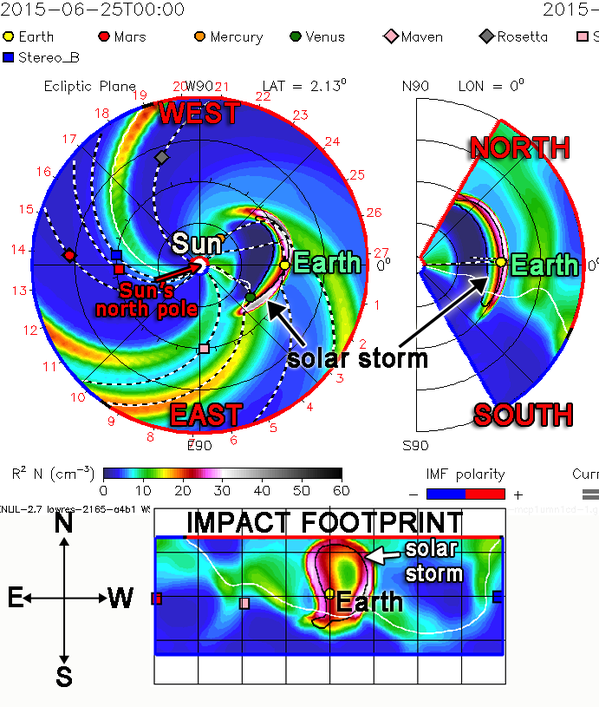
Earth-directed solar storm to hit Earth early June 25th

NASA predict model shows next Earth-directed solar storm hits early June 25! Expect ham radio, GPS issues, possible Aurora

LATEST SOLAR NEWS:
June 23rd 08:55UTC Solar flaring is easing back and so is the proton radiation. The geomagnetic disruptions remain severe and we have another CME en route from yesterdays M6.5 event. I believe the shockwave will reach earth tomorrow night, NASA and NOAA believe it will be Thursday morning.

June 23rd 00:00UTC After reviewing the SOHO LASCO images, I can confirm that the CME from today’s M6.5 is a full halo, and earth-directed. (June 22 2120UTC) KP8 (Level 4 Magnetic Storm) has set in at earth. We now have significant geomagnetic and radiation events.
http://spaceweathernews.com/


G4 - Severe geomagnetic storm (Kp 8+) - High latitude sky watchers have a very high chance to see strong aurora. The entire middle latitudes have a high chance to see aurora. The low latitudes have a chance to see aurora on the northern or southern horizon, depending on which hemisphere you are located.
http://www.spaceweatherlive.com/en/news


This chart shows the sunspots, the general magnetism around them, and the coronal holes (CH). The sunspot and CH numbers are provided as well. Red is negative, Blue is positive.
This chart is created by Solen.info (a terrific resource)

This chart shows the coronal holes currently on the earth-facing disk. The CH number is provided as well. Use this in conjunction with the chart to the right.
This chart is created by Solen.info


This chart shows the current sunspot number and tracks it since 2000. This cycle was weaker than most, one of the weakest on record. It appears we will soon descend into solar sunspot minimum, but on the descent we may see powerful (albeit fewer) solar flares.


This chart is yet another one from Solen.info – it shows the current solar cycle sunspot counts compared to previous cycles.


Radiation Storm and Strong CME Alert | S0 News June 22, 2015

Published on 22 Jun 2015
Observing the Frontier Conference: https://www.eventjoy.com/e/suspicious...

www.Suspicious0bservers.org
www.SpaceWeatherNews.com
www.MagneticReversal.org
www.ObservatoryProject.com
www.EarthChangesMedia.com [Under Construction]

Discussing Earthquakes with Kongpop: https://www.youtube.com/watch?v=ThCUZ...
Pause on Pausing the Pause: https://www.youtube.com/watch?v=CZH46...
Earth's Magnetic Reversal: https://www.youtube.com/watch?v=sIayx...
Top 6 Climate Change Problems: https://www.youtube.com/watch?v=4Ew05...
Sun Series: http://www.youtube.com/playlist?list=...
10 Amazing Solar Eruptions: https://www.youtube.com/watch?v=1qBwm...

Original music by NEMES1S
http://www.suspicious0bservers.org/shop/ [Get NEMES1S Music!]

REPEAT LINKS:

WORLD WEATHER:
Earth WindMap: http://earth.nullschool.net/#current/...
Global Maps: http://www.atmos.albany.edu/student/k...
NDBC Buoys: http://www.ndbc.noaa.gov/
HurricaneZone Satellite Images: http://www.hurricanezone.net/westpaci...
NOAA Environmental Visualization Laboratory: http://www.nnvl.noaa.gov/Default.php
Satellite Maps: http://www.woweather.com/cgi-app/sate...
Forecast Maps: http://www.woweather.com/weather/maps...
TORCON: http://www.weather.com/news/tornado-t... [Tornado Forecast for the day]
HURRICANE TRACKER: http://www.weather.com/weather/hurric...
GOES Satellites: http://rsd.gsfc.nasa.gov/goes/
THE US WINDMAP: http://hint.fm/wind/
Severe Weather Threats: http://www.weather.com/news/weather-s...
Canada Weather Office Satellite Composites: http://www.weatheroffice.gc.ca/satell...
Temperature Delta: http://www.intellicast.com/National/T...
Records/Extremes: http://www.ncdc.noaa.gov/extremes/rec...

SPACEWEATHER:
NOAA Spaceweather: http://www.swpc.noaa.gov
Spaceweather: http://spaceweather.com
SOHO Solar Wind: http://umtof.umd.edu/pm/
Planetary Orbital Diagram - Ceres1 JPL: http://ssd.jpl.nasa.gov/sbdb.cgi?sstr...
SDO: http://sdo.gsfc.nasa.gov/data/
Helioviewer: http://www.helioviewer.org/
SOHO: http://sohodata.nascom.nasa.gov/cgi-b...
Stereo: http://stereo.gsfc.nasa.gov/cgi-bin/i...
SOLARIMG: http://solarimg.org/artis/
iSWA: http://iswa.gsfc.nasa.gov/iswa/iSWA.html
NASA ENLIL SPIRAL: http://iswa.gsfc.nasa.gov:8080/IswaSy...
Gamma Ray Bursts: http://grb.sonoma.edu/
BARTOL Cosmic Rays: http://neutronm.bartol.udel.edu//spac...
ISWA: http://iswa.ccmc.gsfc.nasa.gov:8080/I...
NOAA Sunspot Classifications: http://www.swpc.noaa.gov/ftpdir/lates...
GONG: http://gong2.nso.edu/dailyimages/
GONG Magnetic Maps: http://gong.nso.edu/data/magmap/ondem...

MISC Links:
JAPAN Radiation Map: http://jciv.iidj.net/map/
RADIATION Network: http://radiationnetwork.com/
LISS: http://earthquake.usgs.gov/monitoring...
QUAKES LIST FULL: http://www.emsc-csem.org/Earthquake/s...
RSOE: http://hisz.rsoe.hu/alertmap/index2.php [That cool alert map I use]
Moon: http://www.fourmilab.ch/earthview/pac...

Sunday, 21 June 2015

NOAA Issues Another Magnetic Storm Watch -- Northern Lights Show Possible

                                                                 LATEST SOLAR NEWS: 

(June 22 1028UTC) We await the 3rd CME shockwave – proton radiation and geomagnetic effects will be the primary things to watch. Flare probabilities remain high on delta class magnetic structures in AR12371.


(June 22 0220UTC) ALERT Strong CME Impact Watch – NASA and NOAA both forecast the last, largest, and most earth-direct CME to arrive by the evening of June 22, 2015 at speeds approaching 850km/s and high density. Such an event can product a strong geomagnetic storm and perhaps even disrupt satellites, avionics, GPS, communications (basically all electronics, including the internet and your cell phone) in minor ways. This CME is almost certainly well-below grid-destroying strength.
http://spaceweathernews.com/

SUN


UPDATE 1: Storm Watch Now Extended to 48 hours.


UPDATE 2: Watch now UPGRADED to STRONG! First 24 hours, 7Kp possible. Second 24 hours, 6Kp possible.


Charged Particles from Sun heading towards Earth.


When does the Aurora storm watch begin?


      The storm watch begins on 22/06/2015 at 01:01:00

      The storm watch starts at the above time and continues for 48 hours.


http://www.softservenews.com/en/aurora-borealis-breaking-news/aurora-storm-watch-news-300066.html


Sunspot region 12371 kicking out flares


Thursday, June 18 2015 - 12:23 UTC


A coronal mass ejection (CME) is a massive burst of solar wind and magnetic fields rising above the solar corona or being released into space.
Coronal Mass Ejections take about  20 to 40 hours to reach the earth. 
CMEs can give rise to ionospheric storms. These can provide a short lived enhancement to ionospheric radio propagation conditions but before long this can result in a black out to radio communications via the ionosphere. 
Lookout for a possible Aurora, If the CME couples strongly to the Earth's magnetic field the Aurora may be visible.


Since then we have had more flares
On June the 20th at 07:09 we had a moderate M1.01 solar flare
On June the 21st at 02:00 we had a moderate M2.03 solar flare
On June the 21st at 02:57 we had a strong M2.69 solar flare
On June the 21st at 10:03 we had a strong M3.87 solar flare
On June the 21st at 18:39 we had a Moderate M1.14 solar flare
All were from from sunspot region 12371


Dr. Tamitha Skov ‏@TamithaSkov Tweeted
M-flare is double peaked & rises to M2.2! Launching Earth-directed solarstorm now! Likely impact at Earth June 24-25!


Halo CME ‏@halocme Tweeted
Almost circular halo CME (Earth-directed, expected arrival June 23/24). It was associated with M flare. Nice dimming.


SolarHam ‏@SolarHam Tweeted
CME originating from flare site tonight appears to be full halo and Earth directed. More to follow.


SpaceWeatherLive ‏@_SpaceWeather Tweeted
A full halo CME is now becoming visible from the M2.0/M2.6 flare. Impact at Earth very likely. More later.


sunspot 2371 with earth to scale, captured today by Philippe Tosi.
 

Monday, 8 June 2015

Minor geomagnetic storm

G1 - Minor geomagnetic storm (Kp 6-) - High latitude sky watchers have a chance to see visual aurora. The higher middle latitudes might see aurora on the northern or southern horizon, depending on which hemisphere you are located. 


Aurora Forecast For The Northern Hemisphere